The standard method for digital metering is to use the maximum
possible sample value
as a reference point. This value is referred to as 0 dB. Decibels are
used to represent fractions logarithmically. In this case, the fraction
is: sample amplitude divided by the maximum possible amplitude. The actual
equation used to convert to decibels is: dB = 20 log (amplitude/32,768)
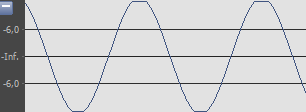
To illustrate this, consider a sine wave with a peak amplitude
of 50% of full scale. Inserting the values in the appropriate places yields
20 log (0.50) = -6.0 dB. Each time a signal's amplitude is divided by
two, its dB value is decreased by 6 dB. Likewise, doubling the amplitude
of a signal increases its dB value by 6 dB. Dividing the sine wave until
its peak amplitude is equal to 1 produces lowest peak dB possible, -90.3 dB.
Why are dBs used when talking about audio?
Decibels are typically used when dealing with sound pressure levels because
of the vast range of sound (about 120 dB) that the human ear can perceive.
It's also easier to say -90 dB than 0.000030 (1/32,768).
When recording to an analog medium such as magnetic tape,
recording engineers typically try to keep VU (volume unit) meters as close
to zero as possible. This ensures a high signal-to-noise ratio while preserving
adequate headroom to keep the tape from saturating and distorting. In
addition, occasional peaks above 0 do not cause problems because the tape
saturation point is not an absolute.
However, this is not true in the digital realm, where amplitudes
are stored as discrete numbers instead of continuous variables. The flexible
recording ceiling of analog is replaced by the absolute maximum sample values
of digital audio. Stored signals must never have a value above these maximums,
as the wave peaks are literally clipped. This clipping adds audible distortion
and though it can go unnoticed, it can also ruin an entire project. Therefore,
sample with the understanding that digital audio has absolutely no headroom.
The following image shows a simple sine wave that has been clipped to
0 dB:
Because digital audio has no headroom, setting the sampling
level becomes critical. If the loudest section of the audio is identified
in advance, the recording level should be set so that the peak is as close
to 0 dB as possible to maximize the dynamic range of the digital medium.
If the loudest section of audio is unknown, allow 3 to 6 dB of headroom
for unexpected peaks.
TIP
From the Tools menu,
choose Find
and use the Find dialog to identify the largest
peak in your file.